Choosing a League of Legends role for a recurring stream segment
Why a segment needs one main role
A consistent role makes the stream easier for viewers to understand. People see the broadcast title, get the topic, and decide whether this content is useful to them. A regular main on a specific position helps build a core audience: lane players are interested in matchups, builds, laning mistakes, macro, and decisions in specific situations.
A segment doesn't require playing one role in every single match without exception. But the main position should account for most broadcasts, otherwise viewers won't be able to predict what the next stream will contain. The downside of rigid specialization is obvious: it limits your choice of games and can lead to burnout from one type of match faster.
Start with a role where you have something to show
A high rank alone doesn't guarantee an interesting broadcast. What matters more for a segment is whether you can explain your actions as the game unfolds: why you're not taking the wave, when you're giving up an objective, why you're swapping lanes, and at what point you're declining a fight. On a familiar role, it's easier to play, read chat, and comment on decisions at the same time.
If you win more often on one position but stay silent and play on autopilot, while on another you can break down every moment, the second role may be better suited for content. The downside of this choice is that an entertaining and clear format doesn't always match your strongest ranked position.
Check which role matches your stream style
The role sets the pace of the broadcast. An aggressive top laner can build the stream around duels, subtle matchups, and playing through an advantage. A calm support can showcase map control, vision work, and setting up teamfights. A jungler gets plenty of reasons to comment on actions across the whole map.
Before choosing, decide what viewers should get from the stream more often: tense mechanical moments, clear lane lessons, constant map analysis, or conversation between key actions. The role should support this style of delivery, not force you to change it every match.
Don't pick a position just because it seems promising for viewership. If you don't enjoy its basic gameplay loop, it will show in your reaction to setbacks and the pauses between active moments. The downside of choosing based on demand without personal interest is a high risk of abandoning the segment after a few weeks.
Top lane: a choice for creators who love breaking down details
Top works for a recurring segment if you're comfortable holding attention on a single matchup for a long time and explaining micro play: wave control, trades, teleport timings, item power spikes, and conditions for split pushing. It's a good choice when viewers come for specific matchups, champions, and repeatable lane decisions.
Test yourself with a simple criterion: after every trade, can you name its purpose and your next plan — freeze the wave, set up a recall, take plates, or create side-lane pressure? If such explanations come naturally, top gives you material even in a quiet game.
The downside of top is that some matches spend a long time in isolation. If you can't fill quiet stretches by breaking down decisions, the broadcast will lose pace. Also, the lane result often depends on events elsewhere on the map, and viewers may perceive this as repeated complaints about the team.
Jungle: a choice for broadcasts with constant map analysis
The jungle role suits you if you like making decisions quickly and voicing them before the situation becomes obvious. There are constant topics for commentary here: clear route, lane priority, counterganks, dragons, Herald, invades, and reading the enemy jungler's position. This kind of content works well in educational streams because viewers see the whole map.
Choose jungle when you can keep the minimap in focus and not lose your train of thought during mechanical actions. A useful sign: after a failed gank, you can explain not only the execution mistake but also the alternative — a different lane, an objective, a clear, or a defensive route.
The downside of the role is the high workload. You have to make decisions, watch lanes, mechanics, and chat all at once. A mistake in the early route can affect the entire game, and the intense pace leaves less time for detailed explanations. A segment needs a reserve of topics so you don't reduce every stream to the same ganks.
Mid lane: a choice for combining mechanics and pace
Mid suits a streamer who wants to combine spectacular moments with a clear stream structure. You can break down the lane, roams, playing with priority, syncing with the jungler, and participation in key fights. Mid champions often provide highlight material, and a wide pool lets you vary the segment's delivery without leaving the position.
The criterion for choosing mid is the ability to switch between your own lane and the map. If you like explaining why you skip minions for a roam, when to stay under tower, and how priority affects the jungler's actions, the role will give you a stable foundation for a series. If you're only interested in solo kills, there may not be enough topics for a long-running segment.
The downside of mid is high competition among streamers and viewer expectations around mechanics. In a popular role, the audience notices mistakes faster and compares your play to other creators. If your pool is built around overly complex champions, the quality of your commentary may drop in tense fights.
Marksman: a choice for systematic content about consistency
A bot lane segment works if you're ready to show not only successful fights but also repeatable work: farming, wave control, duo trades, positioning, and playing around items. This content is useful for players who care about clear skills: how to survive a tough lane, when to switch targets in a fight, how to use a gold advantage.
Choose marksman when you're interested in breaking down a single moment from multiple angles: your position relative to threats, distance to allies, the opponent's available abilities, and the value of the next wave. This role is especially suited to a format that reviews mistakes after a death or a lost teamfight.
The downside of marksman is heavy dependence on the support and the team's overall state. Even quality decisions may not produce a spectacular result if the lane was lost early on. You can't build a stream solely on finding someone to blame: viewers care more about seeing which actions remained available in a bad situation.
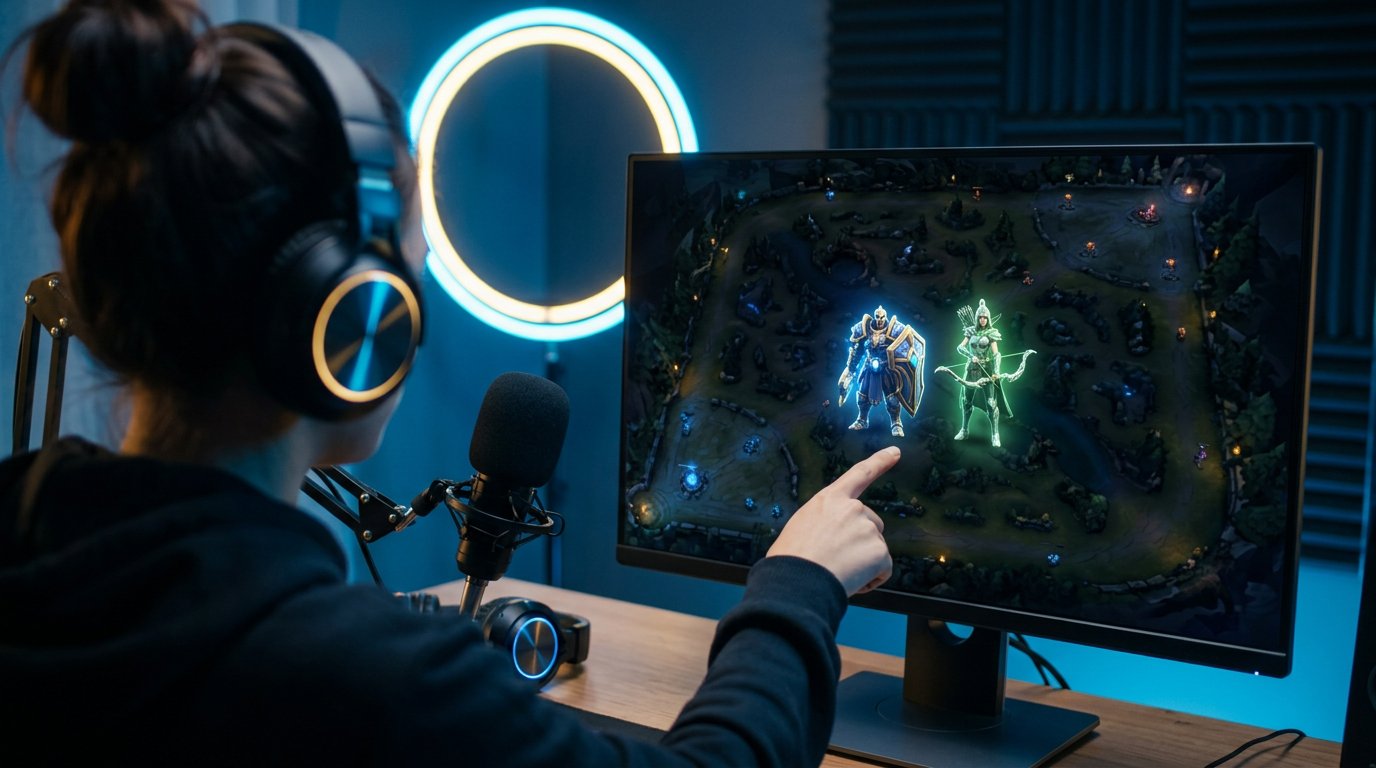
Support: a choice for creators who see value beyond highlights
Support is well suited to a calm, analytical segment. In this role, it's convenient to explain objective setup, placing and clearing vision, choosing when to engage, protecting the carry, and moving around the map. A format that reviews a few key decisions after the match can be especially useful.
Choose support if you like planning the team's actions in advance and noticing moments that rarely make it into montages. A good sign is that you can show viewers how a single ward, a timely retreat, or declining a roam changes the situation a minute later, not just in the moment.
The downside of support is that the spectacle isn't always obvious to a casual viewer. Many important actions don't make it into highlights: a timely retreat, the right ward, declining a dangerous roam. You'll have to learn separately how to show the value of such moments through the minimap, replays, and voice analysis.
Compare roles by how you feel during the stream
You can test your choice not only by game results. On one position it's easier to talk with chat; on another you have to stay silent during every tense stretch. One role gives you topics for short clips, another for detailed educational breakdowns. Assess what type of workload you're ready to handle for several streams in a row.
- If you find it easy to explain mechanics and matchups, top or mid are often the better fit.
- If you want to constantly read the map and discuss plans, try jungle or support.
- If you're interested in reviewing repeatable mistakes in teamfights and in lane, you can build a segment around marksman.
- If you get tired quickly from a high density of decisions, jungle may be a poor choice even with a good win rate.
- If you need constant action, a calm support format may feel repetitive.
These guidelines don't replace testing. The same style can work in different positions, but the role should leave you with the energy to comment, react to chat, and break down mistakes without getting frustrated.
Assess your champion pool before launching the segment
A recurring format needs more than one comfortable champion — it needs a working set for different matches. Prepare a few main characters, backup options, and clear reasons for your picks. Then viewers will see not a random pick but the logic: a response to the composition, lane conditions, a convenient game plan.
- A narrow pool gives you recognizability but quickly makes streams look alike.
- A wide pool adds variety but requires more time for practice and updating your knowledge.
- Playing only meta champions makes it easier to find current topics, but the segment depends more on balance changes.
- Playing favorite off-meta picks sets your channel apart, but some viewers may not see them as universal learning material.
Choose a format that supports the role you picked
A position alone isn't enough: viewers need to understand what exactly is happening on the stream. You can play ranked matches with real-time decision breakdowns, run a series on climbing in a role, study a single champion, or review subscribers' replays. Each format requires a different level of focus and preparation.
It's better to establish a repeatable stream structure in advance: briefly state the goal, comment on key decisions, and highlight one or two moments after the game. The downside of a detailed breakdown format is less dynamism. The downside of a pure gameplay format is that it's harder for viewers to understand why they should come back to you specifically.
Don't confuse a role for the segment with a role for ranked
Your best solo queue position may not be the best for your channel. You may win consistently on it but not get topics for conversation. Conversely, a less familiar role can provide plenty of material for teaching your audience if you honestly show the learning process and break down mistakes.
A "learning a role from scratch" format can also become a segment. Its downside is that you can't pass off assumptions as expert advice. Viewers trust you faster when you separate your own experience from proven game principles and openly acknowledge the moments you're still figuring out.
Run a test series before making a final choice
You don't have to lock in a role after one successful stream. Do several broadcasts on the candidates and compare not only viewership but also how you feel after the stream. Note where it was easier to answer chat, whether you had enough topics between fights, and what clips and questions viewers brought up.
- Pick two or three positions you're genuinely interested in.
- Do an equal number of streams on each in terms of substance.
- Use a comparable format: for example, ranked with commentary.
- Write down which topics kept coming up and where conversation arose naturally.
- Note after which role you still have the energy to do the same kind of stream the next day.
- Keep the position on which you're ready to produce content regularly.
The downside of a test period is that your audience will need time to get used to the channel's structure. Don't change roles after every lost match: what's worth evaluating is the sustainability of the format, not a single game.
Build up topics that don't depend on lucky matches
A recurring segment becomes more stable when it has a content plan beyond wins and losses. For each role, you can prepare topics in advance: matchups, mistakes in the first levels, rune choices, map priorities, item breakdowns, patch reactions, and playing against specific compositions.
For top, these could be waves and side lanes; for jungle, routes and objectives; for mid, roams; for marksman, positioning; for support, vision and rotation timings. The downside of a narrow topic grid is that individual topics can run out quickly. So it's useful to alternate between teaching, ranked games, and reviewing viewers' situations.
Lock in the segment's rules in the title and schedule
Viewers shouldn't have to guess whether today's stream will have the usual content. State the role, the stream's goal, or the topic in the broadcast title: top matchups, climbing on a specific position, support game reviews, jungle pool practice. If your schedule has days for other roles, separate them from the main series.
The downside of too strict a schedule is that it can get in the way of reacting to patches, collab streams, and your own fatigue. Leave room for flexibility, but don't blur the foundation of the segment. If the main role temporarily changes, it's better to announce it in advance so your regular audience understands the reason for the format change.
Last Articles
What has changed in design and functionality We have updated the website to make working with it faster and more convenient. The main changes affect ..
Good afternoon, I've collected all the news during this time.: 1. The main news is that prices for twitch viewers have been greatly reduced, while Tw..
1. Use promo code "December2025" for a 15% discount for all our viewers2. We have reduced the base prices for our configurator and the most affordable..
Twitch services are working stably, so we are ready to cooperate with squads, resellers, service owners, bot owners, and many others.Individual te..
We have completely updated our Twitch viewer services, and they are now working stably. We only use high-quality IP addresses for the viewers.The ..
Hello everyone! Today, we are announcing a new feature—"Twitch Viewer Configurator". Now, you can customize any plan for your Twitch channel. Choo..
Greetings, I have compiled a guide for streamers, which will be very relevant at the moment. Now YouTube and twitch have disabled monetization from vi..
We have finally developed the APINow it will be more convenient for our partner sites to work with us.To update the maximum tariffs for YouTube, an up..
Due to the huge popularity of the partnership services and referral program, we have made a cooperation table. The essence is very simple: more live a..
Our Services for Streamers






Our Services for Content Creators