Breaking down audience retention on Tarik's Valorant watch party
A tournament match gives the broadcast a clear stake
Tarik's biggest broadcasts are built around watch parties for VCT matches and international tournaments. Viewers don't open the stream just for the host: they want to see the outcome of the series, a favorite getting eliminated, a comeback after a disastrous map, or the deciding clutch. The match already has drama, so the streamer doesn't need to invent a reason for people to stay another hour.
Tarik's competitive Counter-Strike experience reinforces this structure. He played at a professional level and was part of the Cloud9 roster that won the ELEAGUE Major: Boston 2018. That doesn't make him an expert on every decision in Valorant, but viewers understand why his take on economy, timings, and actions under pressure is worth listening to.
During Valorant Champions 2023, Tarik's channel peaked at over 350 thousand concurrent viewers, according to Streams Charts statistics. A number like that shows demand specifically for a personal viewing of the tournament, not just for the official broadcast.
For your own channel, choose broadcasts where the goal can be stated in one sentence before the start: watch the deciding series, break down a new patch, climb to a specific rank, or test an agent in ranked. A regular match with no goal can be comfortable for regular viewers, but it's harder for a newcomer to understand why they should stay.
Check the rights to show a match before launching a watch party
Tarik operates within the tournament ecosystem and gets access to formats that aren't available to a random channel. You can't assume that any official match can simply be put on your screen. The organizer, platform, or rights holder may have separate rules for co-streaming, restreaming, and showing the game feed.
Before announcing the broadcast, check the terms of the specific tournament: whether co-viewing is allowed, whether the match can be shown in full, whether audio and the analyst desk are permitted, and whether there are restrictions by region and for broadcast recordings. If you don't have rights to the feed, it's safer to run a broadcast discussing the match without showing it, or to choose permitted content.
The format limitation is direct: a big match on its own won't save a channel if the broadcast gets blocked or viewers leave because it's an inconvenient substitute for the official show. The bet should be on your own commentary and clear organization of the broadcast, not on someone else's feed.
Tarik amplifies the moment instead of talking over the match
During a round, Tarik usually doesn't try to talk nonstop. He follows the series and reacts to an unexpected frag, a risky push, a failed retake, or a strange team decision. On a clutch, his emotion appears at the same moment as what the viewer sees, so the reaction feels like a shared experience rather than a rehearsed bit.
After a big play, he can quickly name the reason: the team gave up map control too early, spent abilities before contact, didn't wait for a trade, or misjudged the opponent's economy. The emotion comes first, and the explanation right after it. That way the viewer gets both the reaction and the game context without a long lecture in the middle of the next round.
On your own broadcast, split commentary into two modes. In a tense moment, don't try to explain every action: let the viewer watch. After the round, pick one reason for the outcome and say it in a few phrases. If there are three or four explanations, the key moment will already have lost its relevance.
Short analysis keeps both experienced and casual viewers engaged
Tarik rarely turns a watch party into a full VOD review. His comments are tied to a fresh moment: why the team saved weapons, where they lost information, why a player took a risk, or why an ultimate was used too late. This kind of breakdown is understandable to a viewer who follows the scene all season and to someone who came for one big match.
His approach is based on fundamentals familiar from competitive FPS: occupied space, timing, economy, trades, discipline, and communication. In Valorant, agents and abilities are added to this, so chat may disagree with the assessment of a specific decision. The debate doesn't hurt the broadcast as long as the host doesn't present his opinion as the only correct one.
A useful template for a streamer is a list of five topics: economy, information, positions, abilities, and trades. After a round, pick just one of them. The downside of the short format is that it doesn't replace teaching: detailed breakdowns of maps, your own mistakes, and VODs are better saved for a separate broadcast or video.
Breaks between maps shouldn't be dead air
Tournament Valorant inevitably includes map picks, technical delays, ad breaks, and pauses between series. Tarik doesn't control the pace of the official match, but during breaks he switches to predictions, team form, rosters, controversial decisions from the previous map, and conversation with people in the voice channel.
He doesn't fill every second with complex analysis. After a tough map, viewers may be more interested in discussing who gave away the key round, whether the comeback was real, and what will change next. This lowers the tension before the next stretch of the match and gives chat a reason to join the conversation.
Prepare a few topics for breaks before the broadcast: a prediction for the map, the best player of the series, a controversial buy, the agent composition, a possible adjustment by the losing team. Keep them in your notes and return to predictions after the map. This kind of filler has a risk: if the conversation drifts too far, you can miss the start of the match. A few minutes before returning to the game, bring the focus back to the series.
Chat works as a collective reaction to the match
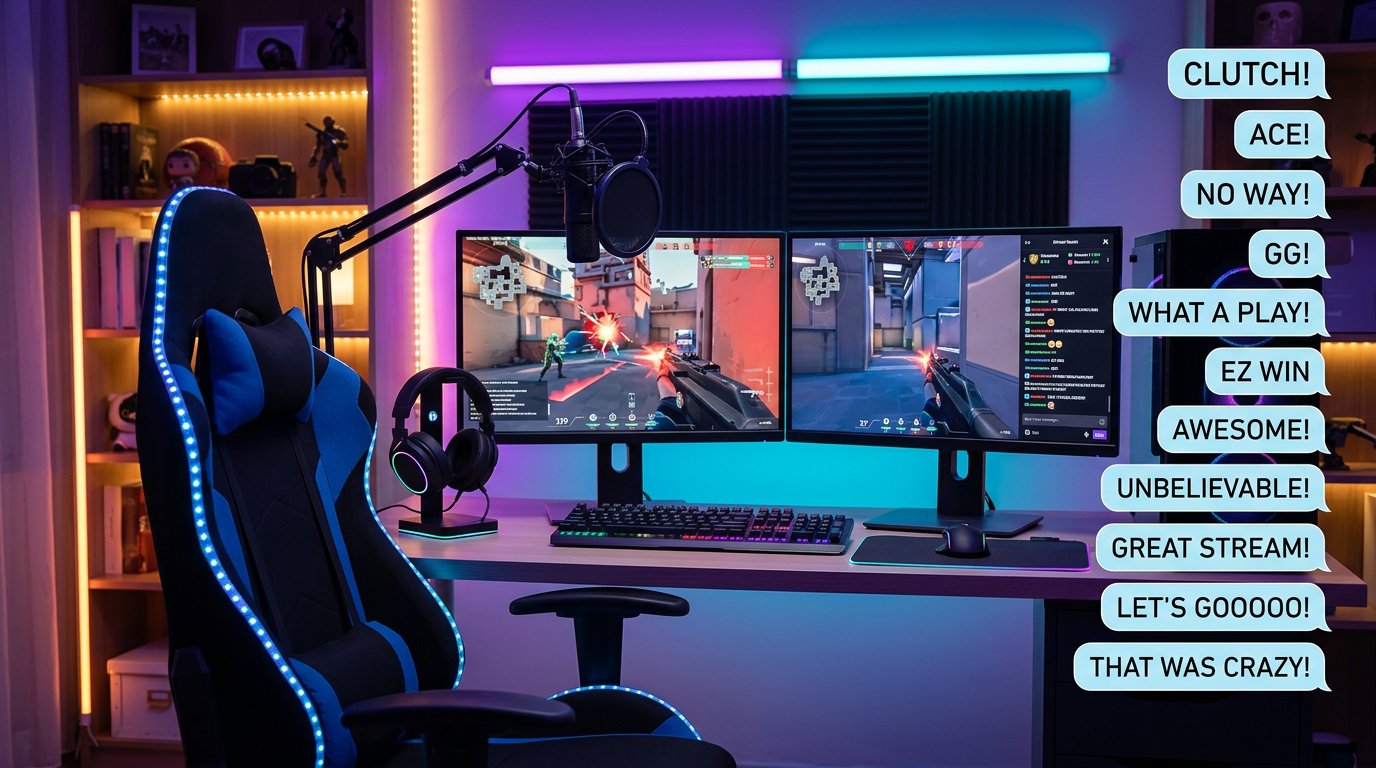
With a large audience, it's impossible to read every message. Tarik reads the overall mood: viewers argue about a team's strength, doubt a clutch, cheer for a comeback, or pick up a meme after a failed round. One short reply to that wave is enough to keep chat from looking like decoration.
The best points for interaction are before and after a map. Before the start, you can collect predictions, ask who the favorite is, or discuss an agent pick. After the map, return to wrong expectations and ask people to name the turning-point round. During a deciding clutch, there's no need to read messages: the viewer came to watch the moment, not to wait for a reaction to an individual comment.
Define two or three chat questions for each series in advance and assign moderators for big broadcasts. Without moderation, activity quickly turns into spam, insults, and conflicts that distract from the match. Don't try to answer everyone: pick recurring opinions or messages that move the discussion forward.
Inside jokes should make sense to new viewers
Tarik has a recognizable conversational style: quick remarks, irony after strange decisions, emotional repetitions, and lively interaction with people in the voice channel. Memes grow out of these reactions, and chat uses them in similar situations. For the regular audience, it's a familiar ritual and a reason to come back for the next broadcasts.
What works isn't a command to "spam this phrase" but the connection between a joke and a specific moment: a failed round, an incredible ace, a controversial call, or the host's reaction. That way the meme has a story, not just a set of words. The match remains the main event, so someone who doesn't know the old jokes still understands what's happening.
Don't copy other people's phrases and intonations. Notice what your audience repeats on its own after a broadcast, and occasionally bring it back into the conversation with a short bit of context. If the whole stream is built on the local language of old viewers, a newcomer will feel out of place and close the stream.
Guests are useful when they have a role in the broadcast
Tarik's watch party often isn't a solo monologue. Content creators, players, and acquaintances from the FPS scene add different reactions to the same round. One guest might support a risky push because of the score, another might criticize it because of economy and ultimates. The viewer is interested not only in the answer to who's right, but in the argument itself with its reasoning.
For a small channel, a guest doesn't have to be a famous player. They might know a specific role well, play at a high rank, follow a region, or simply be able to keep a conversation going without pauses. Before the broadcast, agree on who leads the match, who watches chat, and who chimes in on controversial decisions.
The guest format has a weak spot: a loud guest can drown out the match, while a passive one adds nothing beyond being present in Discord. If someone regularly steers the conversation off topic or interrupts the climaxes, their participation lowers retention instead of raising it.
Commentary pace changes with the course of the series
Tarik's record viewership is tied to important matches, but retention isn't built on a single number. He changes the density of commentary to match what's happening: a one-sided map doesn't need artificial drama, and a tense finish doesn't need long explanations. The host stays noticeable but doesn't compete with the game for attention.
This matters especially for your own channel, where a match may turn out duller than expected. There's no need to shout after every frag to create a sense of occasion. Reactions that appear only at truly important moments land harder with viewers. A repeatable style matters more than copying someone else's volume.
Before the start, define the points where you must engage: the start of the map, a key economic round, the side switch, match point, and the end of the series. Between them, leave room for the game, chat, and calm commentary. This framework helps you avoid burning out on a long broadcast, but it requires discipline: a monotonous tone quickly turns even a good match into background noise.
A practical broadcast plan based on Tarik's approach
- Before the series starts, define the stake of the broadcast and state it to viewers.
- On each map, collect one chat prediction and keep it until the result.
- During a big round, live the moment first, then name one game reason for the outcome.
- During breaks, use prepared topics rather than random conversation.
- After the map, return to the prediction, pick the turning-point moment, and ask chat for their opinion.
- Bring in a guest only with a specific role: analysis, debating decisions, or engaging the audience.
- Make sure inside jokes complement the match rather than replace discussion.
This plan doesn't guarantee viewership on the level of big watch parties: Tarik has a multi-year audience, a reputation in FPS, and access to major events. But it helps make a broadcast consistent: viewers get a reason to show up before the start, stay for the deciding round, and come back for the next series.
Last Articles
What has changed in design and functionality We have updated the website to make working with it faster and more convenient. The main changes affect ..
Good afternoon, I've collected all the news during this time.: 1. The main news is that prices for twitch viewers have been greatly reduced, while Tw..
1. Use promo code "December2025" for a 15% discount for all our viewers2. We have reduced the base prices for our configurator and the most affordable..
Twitch services are working stably, so we are ready to cooperate with squads, resellers, service owners, bot owners, and many others.Individual te..
We have completely updated our Twitch viewer services, and they are now working stably. We only use high-quality IP addresses for the viewers.The ..
Hello everyone! Today, we are announcing a new feature—"Twitch Viewer Configurator". Now, you can customize any plan for your Twitch channel. Choo..
Greetings, I have compiled a guide for streamers, which will be very relevant at the moment. Now YouTube and twitch have disabled monetization from vi..
We have finally developed the APINow it will be more convenient for our partner sites to work with us.To update the maximum tariffs for YouTube, an up..
Due to the huge popularity of the partnership services and referral program, we have made a cooperation table. The essence is very simple: more live a..
Our Services for Streamers





Our Services for Content Creators