
Doubled Game Audio in OBS via Capture Card: Finding and Eliminating the Duplicate
Why the game sounds twice in OBS
Doubled audio appears when OBS receives one game signal through two routes. A common case: the capture card passes audio along with video, while Windows simultaneously plays that same signal to your headphones. If the headphones are captured as "Desktop Audio," the game comes back into OBS as a second channel.
A duplicate is also created by a separate audio source for the same card, listening to the input in Windows, the card's viewing software, OBS monitoring, and virtual audio cables. First determine where the duplicate is heard: only in headphones, in the recording, in the stream, or everywhere. To check, make a short local recording with the game and your voice.
Check the channels in the OBS audio mixer
Launch the game and watch the OBS audio mixer. If the game audio moves the meters on two channels at once, the signal has been captured twice. Usually these are "Video Capture Device" and "Desktop Audio." The second route may be a separate input audio capture source using the same card.
Only one source should remain in the mixer for game audio. Don't try to fix the duplicate with filters, delay, or different channel volumes. Delay is for synchronization, but it doesn't remove the copy of the signal.
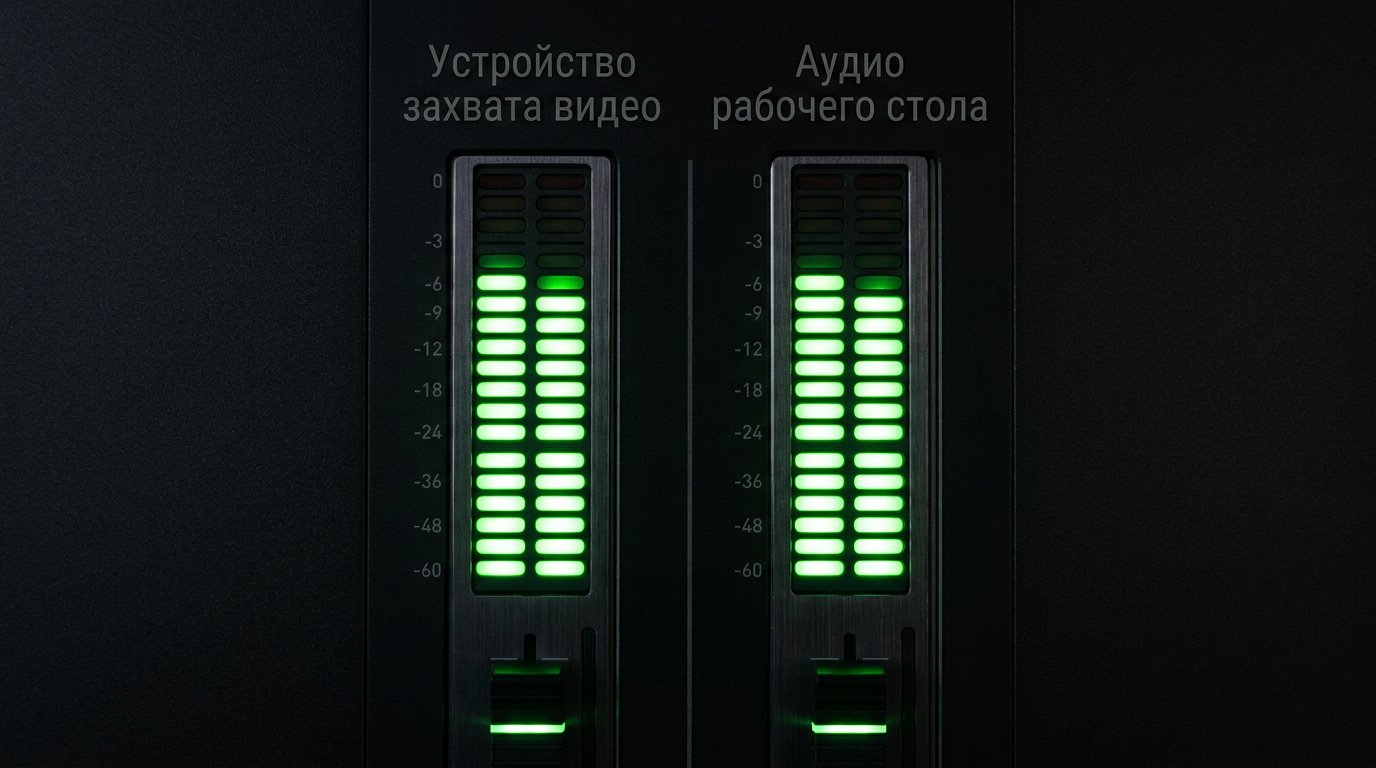
- Disable suspicious channels one at a time and make a test recording after each change.
- Check whether the same capture card has been added to the scene twice.
- Open other scenes and nested scenes: an old card source may still be active there.
- Look not only at the channel name but also at the device selected in its properties.
Choose one method for capturing the card's audio
Usually the card passes video and audio within the "Video Capture Device" source. In its properties, OBS receives the card's audio and shows a separate strip in the mixer. For most scenes, it's enough to add the card once and leave the built-in audio enabled.
Another option is to disable audio on the video capture source and add the card as a separate input audio capture source. This is convenient when you need your own filters, level, or recording track. The downside of this setup is that it's easy to forget to disable audio on the video capture and end up with two identical channels again.
After choosing a method, launch the game. Its audio should move only one meter. For different volumes in the recording and the stream, use tracks and advanced audio properties, not a second capture of the same card.
Exclude the card from "Desktop Audio"
"Desktop Audio" captures everything Windows sends to the selected output device: headphones, speakers, a monitor, or a virtual channel. If the card's audio is played through that device, OBS will record the game again: directly from the card and through the system audio.
Open "Settings" → "Audio" → "Global Audio Devices." Check "Desktop Audio" and "Desktop Audio 2." If they're only needed for the card, select "Disabled." If the stream needs the browser, notifications, and PC apps, capture them with separate application sources, or don't output the card's audio to the system device.
The downside of disabling "Desktop Audio" is that PC system sounds won't go into the stream automatically. You'll have to add and control them separately.
Disable listening to the card in Windows
Windows can play the capture card's incoming audio to headphones or speakers. This is useful for local monitoring, but it creates a duplicate if the selected device is also captured by OBS's "Desktop Audio."
Open Windows "Settings" → "System" → "Sound" → "More sound settings." On the "Recording" tab, find the capture card device, open "Properties" → "Listen" and uncheck "Listen to this device."
If the checkbox is needed, look at the device selection field below. Don't route the card's audio to headphones, speakers, or a monitor that OBS records as desktop. It's better to choose a separate device that isn't involved in the capture, or listen to the game through the card's HDMI output. The downside of this solution is that you'll need a separate way to monitor the audio.
Check audio monitoring in OBS
OBS monitoring sends a source's audio to the selected device, such as headphones connected to the PC. By itself, it doesn't have to create a duplicate in the stream. The problem arises when OBS outputs the card to the headphones, and "Desktop Audio" captures those same headphones and returns the signal to the program.
Open "Settings" → "Audio" → "Advanced" and check "Monitoring Device." Then, in the audio mixer menu, open advanced audio properties and look at the "Audio Monitoring" column for the card's channel.
- "Monitor Off" — OBS doesn't send the game to your headphones.
- "Monitor Only" — the game is audible locally but doesn't go to the stream through this source.
- "Monitor and Output" — the game is audible locally and remains in the stream through the card's channel.
If "Monitor and Output" is selected, don't capture the monitoring device through "Desktop Audio." The downside of monitoring through OBS is possible audio delay due to processing by the card, driver, and program.
Check virtual audio cables
VB-Audio virtual cables and similar programs often become the second route. For example, the card's audio goes into a virtual input, while OBS simultaneously receives it through "Desktop Audio" and a separate capture source of that same virtual output. Externally this may look like two different devices, even though one signal is flowing inside.
Open the Windows sound settings, the properties of the OBS sources, and the virtual mixer program if one is used. Trace the path from the card to the stream: where the signal enters the virtual cable, where it exits, and which OBS source picks it up. Leave one input into OBS.
Don't assign the same virtual output as both the desktop device and a separate audio source at the same time. The downside of dropping the virtual cable is that it's harder to separate game, browser, music, and voice chat audio onto different tracks.
Close the card's software and extra previews
A capture card may have its own viewing software, mixer, or settings window with local playback. The card's audio can also go through a media player, a browser tab with a preview, or a program for remote console control. In OBS, only one card channel may be moving, but the second will end up in "Desktop Audio."
Close the card's viewing software, players, and preview tabs. Then record a short clip. If the duplicate is gone, disable local playback in the program or don't launch it during the stream. The downside of this method is that you'll lose a separate card preview outside OBS.
Change settings one at a time: first OBS sources, then Windows listening, OBS monitoring, virtual devices, and third-party programs. If you disable everything at once, it will be hard to identify the cause, and you might leave the stream without the audio you need.
A working setup for a console, card, and PC
For example, the console is connected via HDMI to the capture card's input, and the card is connected to the PC. A video capture source is added in OBS, and the game audio appears as a separate channel in the mixer. In this setup, you usually don't need to add the same card as a separate audio capture source.
- Leave audio enabled on the capture card source.
- Remove or disable the separate audio source using the same card if it was added earlier.
- Disable "Desktop Audio" if system audio isn't needed in the stream.
- If system audio is needed, don't output the card's audio to the captured device.
- In Windows, turn off listening to the card on the device that OBS records.
- Disable card monitoring in OBS if you're not using it intentionally.
The game should have one path to the stream: capture card → OBS source → stream or recording track. The downside of this setup is that PC system sounds will have to be configured separately.
If the duplicate isn't heard everywhere
Where the duplicate appears helps you find the extra route faster. If only you hear the duplicate in your headphones and the recording is clean, check Windows, the card's software, the TV, or OBS monitoring. The stream path in this case may be configured correctly.
- The duplicate is in the recording — check the card sources, "Desktop Audio," virtual cables, and recording track assignments.
- Viewers hear the duplicate but the recording is clean — check the stream track and the channels enabled specifically on it.
- The duplicate is in both the recording and the stream — the card is usually being captured directly and through system audio, or it's been added as two sources.
- The duplicate appears after launching a specific program — disable the card's audio output in it or close it during the check.
Checklist if the doubled audio persists
- Launch the game and make sure only one game channel is moving in the OBS mixer.
- Check whether the card has been added both as a video capture with audio and as a separate audio source.
- Check whether "Desktop Audio" is capturing the headphones or speakers that the card's audio is output to.
- Uncheck "Listen to this device" in the card's properties on the Windows "Recording" tab.
- Check the OBS monitoring device and the monitoring mode on the card's channel.
- Disable the second route through the VB-Audio virtual cable or another software mixer.
- Close the card's software, players, and browser previews with audio enabled.
- Make a new local recording and listen to it outside OBS.
Last Articles
What has changed in design and functionality We have updated the website to make working with it faster and more convenient. The main changes affect ..
Good afternoon, I've collected all the news during this time.: 1. The main news is that prices for twitch viewers have been greatly reduced, while Tw..
1. Use promo code "December2025" for a 15% discount for all our viewers2. We have reduced the base prices for our configurator and the most affordable..
Twitch services are working stably, so we are ready to cooperate with squads, resellers, service owners, bot owners, and many others.Individual te..
We have completely updated our Twitch viewer services, and they are now working stably. We only use high-quality IP addresses for the viewers.The ..
Hello everyone! Today, we are announcing a new feature—"Twitch Viewer Configurator". Now, you can customize any plan for your Twitch channel. Choo..
Greetings, I have compiled a guide for streamers, which will be very relevant at the moment. Now YouTube and twitch have disabled monetization from vi..
We have finally developed the APINow it will be more convenient for our partner sites to work with us.To update the maximum tariffs for YouTube, an up..
Due to the huge popularity of the partnership services and referral program, we have made a cooperation table. The essence is very simple: more live a..
Our Services for Streamers








Our Services for Content Creators






