Your First GTA VI Stream: Playthrough, Challenge, or Exploration
Start with a clear idea for the broadcast
Your first GTA VI stream should have one clear objective. The viewer should understand it from the title and the first minutes of the broadcast: you're playing through the game, testing a specific restriction, or exploring the available world. If you mix all the formats into a single stream, the broadcast may lose direction, and it will be harder for you to keep up the pace.
Choose not the most flashy option, but the one that matches your strengths. If you're good at explaining what's happening and can hold attention during quiet moments, a playthrough will suit you. If you enjoy a competitive element and reacting to mistakes, consider a challenge. If you easily keep a conversation going and notice details, take a look at exploration.
Until confirmed information about the game's mechanics, story, and content appears, don't build your stream on guesses. Use only the available official information, and clarify specific rules and goals once you can verify them in the game itself.
Playthrough: the most straightforward format to start with
A playthrough works if you want to give viewers a coherent story right away. This kind of stream has simple logic: you start the game, make decisions along the way, and move toward the next goal. The format doesn't require a complicated explanation, so it's easier for someone visiting your channel for the first time to understand.
The main feature of a first playthrough is unpredictability. You may not know how long a particular episode will take, where a difficult moment will appear, or when a pause will come up. That's not a problem if you comment on your actions, explain your choices, and don't try to pose as an expert where you're seeing the game content for the first time yourself.
You don't have to plan a long marathon. For the first stream, it's better to set a limited goal: get acquainted with the start of the game, complete one major segment, or check out a few available features. That way it's easier for the viewer to decide whether to stay until the end, and easier for you to figure out whether the pace works for continuing.
A playthrough carries a spoiler risk. Warn about them in the title, description, and at the start of the stream. Don't reveal details in advance that the viewer hasn't seen yet, and don't ask chat to recap future events. If you're planning a continuation, a consistent naming style will help viewers find the next episodes.
Challenge: when the stream is built around a rule
A challenge is a broadcast with one verifiable condition. You set a task and try to complete it live. It's clear to the viewer what to watch for: whether you'll manage to get through the chosen segment, hold to a restriction, or achieve a result under the given rules.
For a first stream, this format works if you can react calmly to failures. A mistake should become part of the narrative, not a reason to lose the thread of the conversation. Explain the rules before the attempt begins: what counts as success, which actions are allowed, how many attempts are planned, and what will happen after a failure.
Don't pick a condition that's too difficult before you've tested the game. The mechanics may work differently than you expected, and the task you set may turn out to be either impossible or too easy. First check that the rule can be tracked unambiguously and that it doesn't force you to stay silent for long or repeat the same section over and over.
A good challenge allows for a clear backup plan. If the original goal turns out to be unreachable, you can change the restriction, shorten the segment, or move on to an additional attempt. It's important to tell viewers about the change in advance rather than pretending the new conditions were part of the plan from the start.
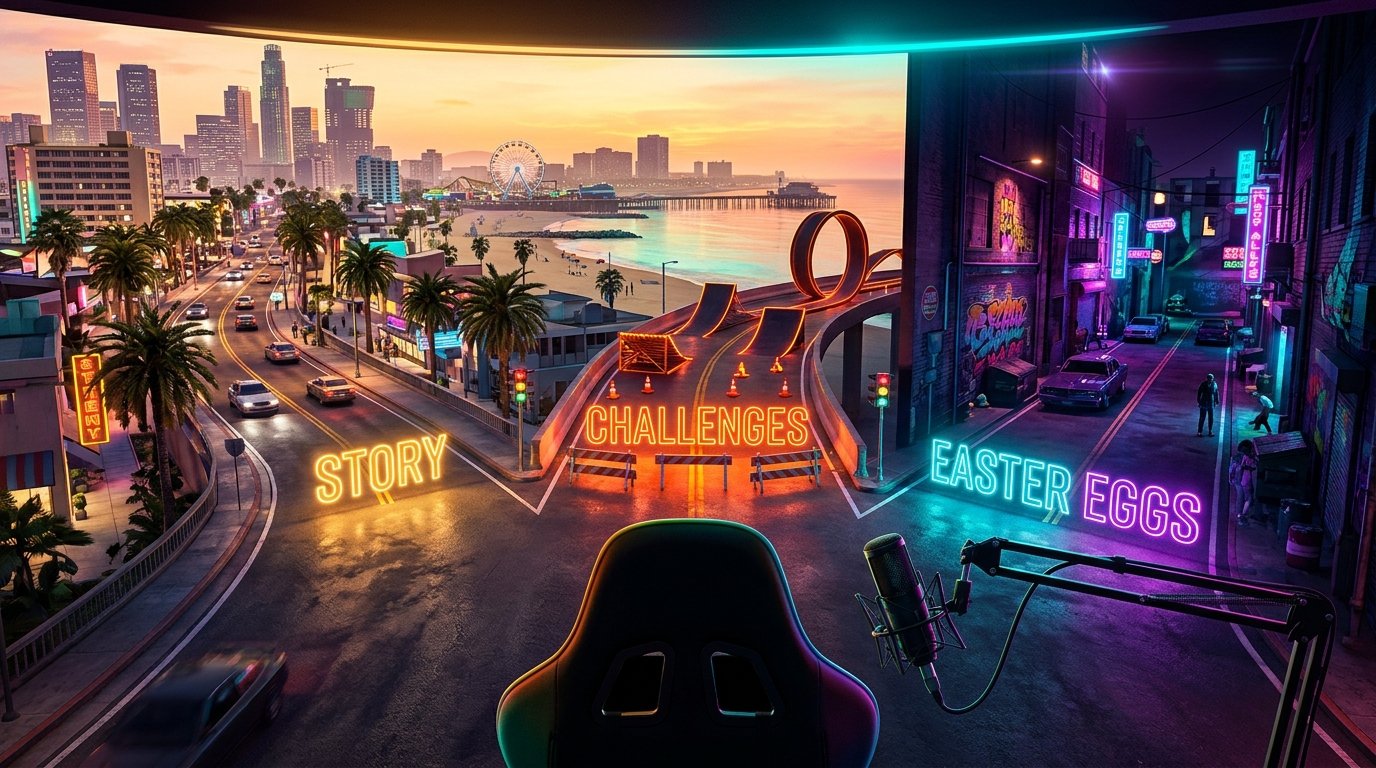
Exploration: a format for observant streamers
Exploration is built not around finishing the story, but around finding details and possibilities. You can study locations, test unusual interactions, compare different solutions, or look for things that are easy to miss during a normal playthrough. This kind of stream suits those who like to think out loud and involve chat in choosing a direction.
The key is to narrow the topic in advance. The phrase "we explore everything" is too vague. It's better to pick one district, type of activity, set of game features, or a specific question you want an answer to. A precise goal doesn't limit the stream; it helps you avoid getting lost when the options become too many.
Viewers can suggest routes, point out inconspicuous objects, and compare your observations with their own. At the same time, don't call a detail you've found a secret or confirmation of a rumor without verifying it. Separate what you've seen in the game from assumptions and information from unverified sources.
The risk of exploration is a slow pace. If you move around for a long time without commentary or interim conclusions, it will be hard for the viewer to understand the value of what's happening. Prepare several directions to check in advance. If one of them turns out to be empty, move on to the next, explaining exactly what you weren't able to find.
How to compare the three formats before streaming
Assess how familiar you are with the game and whether you're ready to act without a script. With limited knowledge of the mechanics, it's safer to start with a playthrough or gentle exploration. A challenge requires more precise preparation: you need to understand the rules, see the limits of what's possible, and be able to quickly explain a mistake.
Consider your audience. It's easier for new viewers to join a playthrough with a clear goal. Loyal subscribers may be more willing to take part in choosing challenge rules or an exploration route. If you don't yet know who will show up to the stream, choose a format with a low barrier to entry and explain the context as the broadcast goes on.
Think about the continuation, too. A playthrough naturally turns into a series of episodes. Exploration can be divided by topics and locations. Challenges are more convenient as separate streams, each with its own objective. The format should help you produce the next piece of content, not depend on one lucky attempt.
Finally, match the idea to your technical conditions. If your stream might get interrupted, don't choose a goal where a continuous attempt matters. If you're not yet confident in your sound and scene settings, start with a calmer format so you can keep an eye on the stream and the conversation with your audience at the same time.
How to set up your first stream
The title should immediately convey the format and the goal. For a playthrough, state that it's the start of the game or the first introductory episode. For a challenge, put the restriction front and center. For exploration, specify exactly what you're going to check. Don't use promises about secrets, records, or unique finds if you can't confirm them in advance.
At the start of the stream, briefly explain the plan: what you'll be doing, roughly how long the chosen segment will last, and how viewers can participate. If the game or certain details are still unfamiliar to your audience, give the necessary context without recapping the story. After that, get to the action without turning the intro into a long presentation.
Prepare a few questions for chat. In a playthrough, this could be a choice between courses of action; in a challenge, a decision about the next attempt; in exploration, a direction to search. Don't hand viewers full control if it gets in the way of the stream's goal, but give them clear points of influence.
After the broadcast, note the moments you can use separately: an unexpected result, a controversial decision, a failed attempt, or a detail you found. Such fragments help show the idea of the stream to those who didn't watch it in full. At the same time, don't give away key story events in the title of a short video without a warning.
Takeaways: what to do step by step
- Determine what's easier for you to run live: a sequential playthrough, following a rule, or free exploration.
- State one goal for your first stream in a single sentence.
- Check the available mechanics and don't use unconfirmed information about GTA VI.
- Prepare the rules, a backup plan, and a few questions for chat.
- Indicate the format and possible spoilers in the title and description, and after the stream, assess which option is worth continuing.
Last Articles
What has changed in design and functionality We have updated the website to make working with it faster and more convenient. The main changes affect ..
Good afternoon, I've collected all the news during this time.: 1. The main news is that prices for twitch viewers have been greatly reduced, while Tw..
1. Use promo code "December2025" for a 15% discount for all our viewers2. We have reduced the base prices for our configurator and the most affordable..
Twitch services are working stably, so we are ready to cooperate with squads, resellers, service owners, bot owners, and many others.Individual te..
We have completely updated our Twitch viewer services, and they are now working stably. We only use high-quality IP addresses for the viewers.The ..
Hello everyone! Today, we are announcing a new feature—"Twitch Viewer Configurator". Now, you can customize any plan for your Twitch channel. Choo..
Greetings, I have compiled a guide for streamers, which will be very relevant at the moment. Now YouTube and twitch have disabled monetization from vi..
We have finally developed the APINow it will be more convenient for our partner sites to work with us.To update the maximum tariffs for YouTube, an up..
Due to the huge popularity of the partnership services and referral program, we have made a cooperation table. The essence is very simple: more live a..
Our Services for Streamers







Our Services for Content Creators