How to build a content plan around a single esports discipline
Why a channel needs focus on a single discipline
A channel dedicated to a single esports discipline is easier to make clear to the viewer. Users immediately understand what is being discussed here, which broadcasts to watch, and why they should subscribe. You don't have to re-explain the channel's topic every time and gather an audience around random games.
Narrow specialization doesn't mean all publications have to be the same. One discipline offers many directions: matches, teams, players, tournaments, tactics, updates, history, training, memes, and community discussions. The task of a content plan is to connect these directions into a single system, not just to compile a long list of topics.
First, define the main promise of the channel. For example, it could be analysis of professional matches, help for beginners, news from a specific scene, or entertainment broadcasts with viewer participation. One project can combine several goals, but one of them must be primary. Then publications will work toward a recognizable channel image.
A content plan is needed not only for regularity. It helps distribute effort in advance, not forget about important events, prepare materials before a tournament starts, and see gaps in topics. At the same time, the plan shouldn't turn into a rigid schedule that can't be changed after news appears or a match is rescheduled.
It's convenient to divide the plan into three levels. The first is the core product: live streams, original videos, or analytical episodes. The second is materials that bring new viewers to it: clips, Shorts, TikTok, and short posts. The third is publications for communication and bringing the audience back: questions, polls, reactions, and announcements. This structure helps avoid confusing a reach-oriented video with material meant to retain regular viewers.
Consider the different mechanics of Twitch, YouTube, and TikTok
The same content can't be transferred unchanged to all platforms. On Twitch, the main event is usually the live stream. What matters here is a clear category, stream title, schedule, chat activity, and a reason to stay on the broadcast. A clip from a stream can attract attention, but by itself it doesn't replace a full broadcast and doesn't explain to the viewer why they should come back.
YouTube works with several formats at once. A long video or VoD can gather views from search and recommendations, a live stream builds the habit of returning, and Shorts provide a short entry point for new viewers. For a long video, what's especially important is the match between title and content, the clickability of the thumbnail and title, retention, average view duration, and transitions to other videos.
TikTok is oriented toward the viewer's quick decision — to keep watching or scroll past. At the start of a short video, you need to establish the conflict, mistake, strong moment, or conclusion. Here it's useful to track average watch time, completions, rewatches, reactions, shares, saves, profile visits, and subscriptions. A long intro, bumper, or context recap without action often hurts the video.
Short vertical videos for TikTok and YouTube Shorts can be made from the same clip, but they don't have to be published with identical text and description. An emotional moment may work better on one platform, a short explanation on another. Twitch should be used as a place of regular live contact, YouTube as a library of detailed materials, and TikTok and Shorts as channels for a first introduction to the creator.
In a working plan, specify not only the topic but also the platform for each idea. The entry "final breakdown" is insufficient. The wording "breakdown of the decisive round in a YouTube VoD, a short takeaway for Shorts, and a discussion on Twitch" immediately shows the scope of work and the connection between publications.
Segment the audience by platform and behavior
A general description like "men and women who like esports" isn't enough for a content plan. Viewers have different reasons for opening material and different actions after watching. Segmentation is better built on two criteria: where the person found you and how they behave after the first contact.
On Twitch, you can distinguish regular stream viewers, active chat participants, silent viewers, and those who came for the first time. Regular viewers care about the continuation of the story, the schedule, and participation in channel decisions. A newcomer needs a quick explanation of what's happening on screen and how this stream differs from ordinary gameplay. A silent viewer isn't necessarily indifferent: they may watch the broadcast but not write in chat.
On YouTube, you can notice search viewers, casual viewers from recommendations, and returning subscribers. The first segment may be looking for a specific answer: how a mechanic works, why a team lost a map, or what changed after an update. For a viewer from recommendations, a clear topic and a strong opening matter. A returning viewer is already familiar with the format and may be ready for deeper analysis.
On TikTok and Shorts, viewers who don't yet know anything about you often predominate. They react to a single moment, a clear mistake, a controversial decision, or an unexpected conclusion. Their behavior is assessed not only by subscription but also by completion, rewatching, profile visits, and watching other videos. Not every short video has to immediately bring a person to a multi-hour stream.
Write a separate task for each segment. For a newcomer — explain a term or show a vivid episode. For an experienced viewer — provide a reasoned breakdown. For a regular viewer — offer participation in the stream, discussion, or choice of the next topic. If a single episode tries to simultaneously teach a newcomer, break down professional tactics, and entertain regular viewers, its structure may become overloaded.
The boundaries of the channel should also be defined in advance. Decide whether you cover only the professional scene, or also add ranked matches, amateur tournaments, and game updates. If the channel is dedicated to Valorant, a separate stream about another game should be an exception with a clear reason, not a regular replacement for the main topic.
Build a topic map around the discipline
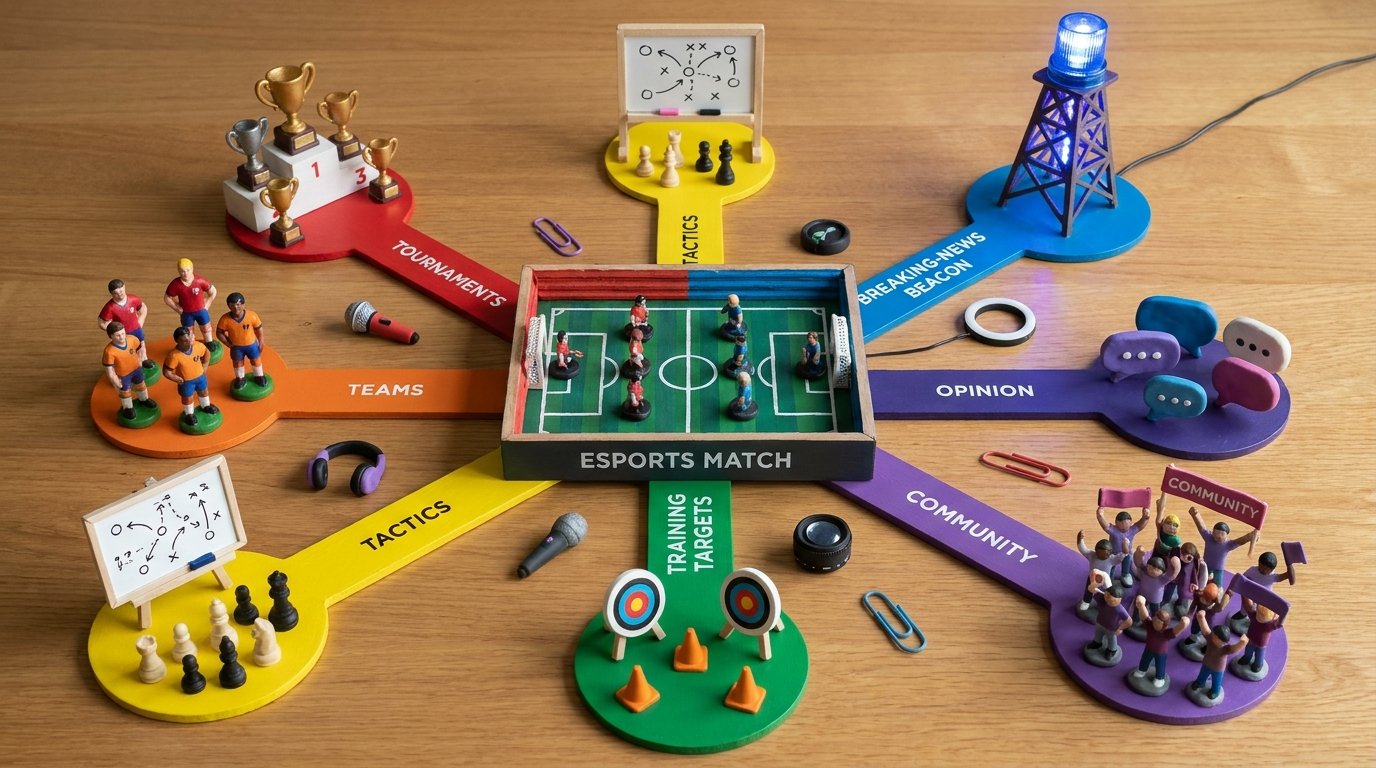
A topic map shows how to move from one discipline to various content segments and formats. At the center is the game or scene; around it are matches and tournaments, teams and players, tactics, training, updates, history, and communication with the community. Then each branch is linked to a specific platform and task.
For example, the "matches" branch can lead to a community announcement, a Twitch live stream, a detailed YouTube VoD, and a short clip with one decisive moment. The "training" branch — to a series of search-oriented YouTube videos, short explanations for Shorts, and a stream with breakdowns of in-game situations. This way one topic turns not into copies of a single piece of material but into several independent points of contact.
In a content plan, it's useful to separate event-driven topics from evergreen ones. The former include matches, draws, transfers, rosters, updates, and organizer decisions. The latter include explanations of roles, breakdowns of typical mistakes, team history, basic mechanics, and teaching game reading. Event-driven content provides a reason to publish now, while evergreen content sustains the channel between tournaments.
Sources are also part of the map. For a news item, note in advance the official publication of the tournament, team, player, or developer. For analytics, save the match recording, statistics, timecodes, and your own observations. This reduces the risk of confusing fact, commentary, and assumption.
Choose recurring content segments
A content segment should answer a specific viewer question and have a repeatable format. "News" is not just a retelling of the feed but a clear explanation of what happened and why it matters. "Analytics" should show the connection between a player's or team's decision and the result. "Training" answers the question of what the viewer can apply in their own game.
For one channel, a few directions are enough. Their number depends on the time available for recording, editing, and preparation. If you only have a few hours a week, it's better to maintain two or three segments than to constantly reschedule six.
- News and context: a short episode about an event with an explanation of its consequences.
- Match or map breakdown: a step-by-step analysis of decisions, mistakes, pace, and key episodes.
- Training: one term, mechanic, technique, or typical mistake in one piece of material.
- Reactions and opinion: a personal stance on a result, roster, controversial decision, or update.
- Practice streams: playing, watching permitted material, answering questions, and communicating with viewers.
- Scene materials: team history, the coach's role, a player's journey, or tournament specifics.
Content segments should differ not only by name. For each, write down the usual length, platform, target audience, call to action, and primary metric. For example, for a training Short, completion and saves matter; for a Twitch stream — average audience, watch duration, and chat activity; and for an analytical YouTube video — clickability, retention, and average view duration.
Examples of content segments for CS, Dota, and Valorant
The following are not ready-made promises about reach but examples you can start from. Choose one discipline and repeat a clear episode logic: one question, one main conclusion, and a suitable format.
If the channel is dedicated to CS
The "One round — one decision" segment suits Shorts and TikTok. In the video, you can show a short fragment, establish the situation, and explain why the player chose a specific action. For a clip, the moment itself matters; for a vertical video, the context before it and the conclusion after it matter.
"Round under the microscope" is better explored in a YouTube VoD. In the episode, you can step by step break down the setup, positioning, grenade usage, pace changes, and the mistake that affected the result. Such material should be linked to a Twitch stream where viewers offer their versions and ask questions about the recording.
On Twitch, the "Post-match map breakdown" segment can work: first comes a viewing of a selected episode, then a discussion of decisions and viewer answers. In the calendar, note in advance which moments you will break down so the stream doesn't turn into a retelling of the entire map.
If the channel is dedicated to Dota
For short videos, the "Why the fight was lost" segment will work. One clip shows the episode, while voiceover or subtitles explain what changed the outcome: the order of actions, positioning, target selection, or starting the fight too early. Don't try to break down the entire game in a short video.
On YouTube VoD, you can create a "Map of decisions" series: break down how the team moved from lanes to objectives, why it chose a specific route, and which actions created an advantage. The title should denote a specific question, not promise an abstract "full match analysis."
For Twitch, a stream with one learning task will work: for example, viewers and the creator track movements across the map or discuss decisions in specific in-game situations. After the stream, you can prepare a clip from the strongest explanations, but don't publish it without context.
If the channel is dedicated to Valorant
The "Retake step by step" segment can exist as a clip and as a Short. The short version shows the situation, one wrong choice, and a clearer sequence of actions. On TikTok, you can emphasize the mistake, while on Shorts — the brief training takeaway.
"Mistake on defense" suits a YouTube VoD if the episode is built around several connected episodes. First state the problem, then show examples, and finish with rules the viewer can test in their own game. Don't mix positioning, economy, and communication mistakes in one video without a common theme.
On Twitch, you can run a "Map breakdown with chat": choose one map, gather viewer questions, and examine controversial rounds live. If the topic sparks active discussion, after the broadcast you can release a post with the main takeaways and direct viewers to the full VoD.
Connect live, VoD, clips, and short videos
A live stream shouldn't be the only result of your work. Before it, you can release an announcement with a specific topic; during the stream, mark timecodes; and after it, select several standalone materials. This approach helps use an event several times without turning all publications into identical cuts.
A clip answers the question "what happened?" Shorts or TikTok can answer the question "why does this matter?" or "what's the takeaway?" A VoD reveals the context and sequence of decisions. The next live stream continues the conversation and gives the audience a chance to participate. If a single recording only yields a set of fragments without new value, the content chain should be reconsidered.
An example for a match in one discipline looks like this: before it starts — a short prediction with one controversial question; during it — a Twitch stream or discussion; right after — a clip with the decisive moment; then — a YouTube VoD with a breakdown; a few days later — a short training video on the technique used. Each piece of material should have its own angle, not a repeat of the same retelling.
Consider the technical differences. Live requires moderation, a stable schedule, and a communication plan. VoD requires editing, timecodes, and a clear structure. A clip needs a climax point. TikTok and Shorts require a vertical frame, a fast start, and standalone meaning. Therefore, in the table for each publication, specify not only the source material but also the list of changes for the new platform.
Link the plan to the event calendar
Mark tournament stages, important matches, transfer periods, update releases, and confirmed organizer decisions in a separate calendar. Don't fill it with rumors without a source. Unverified information can lead to an error in the title, a wrong prediction, and a loss of trust.
For each event, create several time points. Before the match, you need material with context and expectations. On match day — a stream, a short reaction, or a discussion. After the match — a breakdown of the key decision. Some time later — an evergreen piece that explains the technique used or a typical mistake.
Prepare a backup in advance. If a match is rescheduled, its place is taken by a training episode or material about a team. If an unexpected news hook appears, you can replace a short publication but not cancel the entire plan. It's better not to schedule a big VoD right next to an event if watching the recording, fact-checking, and editing may require extra time.
During periods without major tournaments, use topics that don't depend on the date: basic explanations, mistake roundups, scene history, breakdowns of in-game decisions, and answers to recurring questions. This way the channel doesn't disappear from view between matches.
Create a weekly plan you can actually execute
The schedule should account not only for publications but also for preparation. Time is needed for finding sources, recording, editing, creating thumbnails, replying to comments, and moderating chat. A streamer shouldn't plan as many complex analytical episodes as a team with an editor and video editor produces.
An example of a simple week for a channel about one discipline:
- Monday — a post or short video with the main event of the week and a question for the audience.
- Tuesday — a YouTube VoD with one detailed breakdown of a match, round, or in-game situation.
- Wednesday — a Twitch stream on the topic of the week: playing, discussion, or answering viewer questions.
- Thursday — a clip from the stream with standalone context and a short version for Shorts or TikTok.
- Friday — a short training video on one mechanic or mistake.
- Day off — a reserve for urgent news, rescheduled material, or rest.
This is a template, not a mandatory norm. If you can't manage to prepare a VoD and a stream in one week, keep one main format and one short one. A stable schedule you can maintain is more useful than an overloaded one with constant rescheduling.
For each row of the table, specify a working title, discipline, content segment, platform, format, target segment, source, deadline, status, and primary metric. Leave a separate field for a link to the published piece and a note on the result. Keep ideas without a deadline in reserve so they don't get mixed up with mandatory tasks.
Define metrics before publishing
A plan without measurement quickly turns into a list of completed tasks. For each content segment, define in advance which viewer action shows its value. Views alone don't explain why material worked or didn't work.
For YouTube, track impressions, thumbnail and title clickability, retention, average view duration, average percentage viewed, subscriptions after watching, and transitions to other videos. Clickability helps assess packaging, while retention helps assess whether the content matches the promise. A high CTR with a sharp drop at the beginning may indicate an overly loud promise or a weak intro.
For Shorts and TikTok, what matters is average watch time, completion rate, rewatches, likes, comments, shares, saves, profile visits, and subscriptions. For a training segment, saves and comments with follow-up questions may be more useful than a large number of quick views. For an emotional clip, completion rate and shares may matter more.
For Twitch, look at average viewer count, watch duration, return rate, new subscribers or followers after the stream, chat activity, link clicks, and the number of viewers who came to the next stream. Metrics depend on the format: for a calm breakdown, watch duration and on-topic questions matter more; for a competitive broadcast — return rate and audience stability throughout the stream.
Don't compare metrics from different platforms directly. A TikTok view and a long VoD view mean different depths of contact. Compare videos within the same platform, the same content segment, and a similar format. Note the date, topic, length, platform, delivery style, and external news hook so you don't attribute the result only to the title.
Don't set made-up universal benchmarks. First, build your own baseline from several publications of the same type. Then compare new episodes with the median or average result of your content segment and see which changes repeat.
Use analytics to understand when a content segment isn't working
A content segment needs review if several episodes in a row get weak retention, don't lead to the target action, and don't generate substantive reactions. One unsuccessful publication proves nothing: it could have been affected by the strength of the news hook, the release time, a thumbnail mistake, or a competing event.
If YouTube has low clickability but viewers who opened the video watch it for a long time, the problem may be in the packaging. Check the title, thumbnail, and clarity of the promise without changing the content segment itself. If clickability is normal but retention drops sharply at the beginning, shorten the intro and get to the match, episode, or conclusion faster.
If short videos get views but produce almost no profile visits, the connection to the creator and the main channel may not be established. Add a standalone takeaway, a clear description of the continuation, and a logical transition to the full breakdown. If both completions and rewatches are low, check the first frame, length, pace, and whether there's one clear event.
If a Twitch stream loses viewers after it starts, check the first minutes, the stream title, and whether it matches the announcement. If people watch but don't return, there may be no recurring topic, clear schedule, or continuation. If the chat is silent, don't conclude that no one is interested in the stream: ask specific questions and also monitor watch duration and return rate.
Make a decision about a content segment based on several episodes. First, change one element — the opening, length, title, visual delivery, or call to action. If you change everything at once, you won't understand what affected the result. A content segment can be shortened, merged with another, or temporarily removed if it requires a lot of resources and doesn't confirm its purpose.
Verify facts and material rights
Working with esports often involves using match fragments, images, music, and other people's publications. Before posting a tournament recording or a large match excerpt, check the platform rules and the rights holder's terms. Public access to a video doesn't mean it can be freely copied.
For analytical material, add your own commentary, explain the context, and use only the amount of source material necessary for the breakdown. This doesn't override the rights holder's requirements. When working with someone else's statistics, images, and quotes, verify the source and usage rules.
Separate confirmed fact, source commentary, and your own assumption. If a roster, transfer, or organizer decision isn't yet confirmed, indicate the status of the information or postpone publication. Before release, check names, team names, the result, date, competition format, and whether the conclusion matches the shown episode.
Quick takeaways: what to do step by step
- Choose one discipline and formulate the main value of the channel for the viewer.
- Segment the audience by platform and behavior: new viewers, regular viewers, chat participants, search audience, and short-video viewers.
- Build a calendar of matches, tournaments, and updates, and keep a reserve of evergreen topics alongside it.
- Choose several content segments and, for each, define the viewer's question, format, platform, and scope of work.
- Connect live, VoD, clips, Shorts, and TikTok around one topic, but adapt the material to the mechanics of each platform.
- Create a feasible weekly schedule with a backup window and separate statuses for ideas, preparation, publication, and analysis.
- Before publishing, assign the primary metric: clickability, retention, average view, completions, return rate, chat activity, or transitions.
- Compare several episodes of the same content segment, change one element at a time, and keep only the formats that match the channel's goal and available resources.
Last Articles
What has changed in design and functionality We have updated the website to make working with it faster and more convenient. The main changes affect ..
Good afternoon, I've collected all the news during this time.: 1. The main news is that prices for twitch viewers have been greatly reduced, while Tw..
1. Use promo code "December2025" for a 15% discount for all our viewers2. We have reduced the base prices for our configurator and the most affordable..
Twitch services are working stably, so we are ready to cooperate with squads, resellers, service owners, bot owners, and many others.Individual te..
We have completely updated our Twitch viewer services, and they are now working stably. We only use high-quality IP addresses for the viewers.The ..
Hello everyone! Today, we are announcing a new feature—"Twitch Viewer Configurator". Now, you can customize any plan for your Twitch channel. Choo..
Greetings, I have compiled a guide for streamers, which will be very relevant at the moment. Now YouTube and twitch have disabled monetization from vi..
We have finally developed the APINow it will be more convenient for our partner sites to work with us.To update the maximum tariffs for YouTube, an up..
Due to the huge popularity of the partnership services and referral program, we have made a cooperation table. The essence is very simple: more live a..
Our Services for Streamers





Our Services for Content Creators