Why an HDR game becomes washed out in OBS and on stream
Why an HDR game and the OBS broadcast look different
An HDR game renders the image for an HDR display: it uses a wider brightness range, a different transfer curve, and the Rec.2100 color space. A viewer may open the stream on a regular monitor, in a browser without HDR, or in an app that shows the SDR version.
Bright sun, neon, snow, and a white interface need to be compressed into the regular SDR range. If OBS, the encoder, or the platform misinterprets the HDR signal, the frame turns gray, loses contrast, and looks faded or overexposed. For a regular SDR broadcast, the final signal must be Rec.709 with the Limited range.
Choose the chain: HDR all the way to the viewer or an HDR game in an SDR broadcast
The first scenario is when the game runs in HDR and OBS converts it to SDR before sending it to the platform. The viewer gets a Rec.709 image that looks predictable on most monitors, phones, and TVs. This is usually more convenient for Twitch and for broadcasts where a consistent result for the whole audience matters more.
The downside is that the true HDR range won't reach the viewer. Very bright highlights will be compressed, and in complex scenes with snow, fire, or neon, some of the gradations will change.
When it makes sense to send a native HDR stream
The second scenario is passing HDR from the game all the way to the platform. It requires HDR in Windows and in the game, 10-bit capture, HDR settings in OBS, a compatible encoder, and HDR support on the ingest server side. The viewer must also watch the broadcast through an HDR-compatible device and player.
YouTube can accept HDR video and HDR broadcasts with a correct 10-bit HDR signal and metadata. For SDR viewers, the service usually delivers its own converted version. Twitch is safer to treat as an SDR chain until the current documentation and a specific channel's dashboard confirm that HDR broadcasts are accepted and displayed.
The downside of a native HDR broadcast is that the platform, not OBS, does the SDR conversion for part of the audience. You won't be able to exactly replicate its result for every viewer.
What not to do if the platform converts HDR itself
If YouTube or another platform accepted the HDR stream but the SDR version looks washed out, don't try to compensate with a global increase in brightness, contrast, or saturation in OBS. These filters will change the source HDR for all viewers, including those watching on an HDR screen.
First check that the service recognized the input as HDR: the broadcast data, quality options, or the player's technical information should show an HDR marker. If HDR isn't recognized, the problem is upstream of the platform's processing: in the OBS format, the encoder, or the stream metadata.
If HDR is recognized but the SDR version doesn't satisfy you, a practical option is to run an SDR broadcast from the HDR game. OBS will perform tone mapping to Rec.709 Limited before sending. The downside is that viewers with HDR displays will also see SDR.
Basic OBS settings for an SDR broadcast from an HDR game
For an SDR platform, open OBS "Settings" → "Advanced" → the "Video" section. Check the final color output parameters:
- color format — NV12;
- color space — Rec.709;
- color range — Limited.
NV12 is a typical 8-bit format for SDR broadcasting. Rec.709 defines the expected colors, and Limited matches the video range that most encoders, players, and platforms handle correctly.
The downside of 8-bit SDR is that banding may be noticeable on fog, sky, and other smooth gradients. But this is usually less critical than an HDR signal mistakenly sent as SDR.
What a Rec.2100, Rec.709, and range error looks like
An HDR-to-SDR error is noticeable not only by saturation. In a night scene, black asphalt, walls, and shadows turn dark gray. A white interface looks dusty, as if a semi-transparent gray veil were laid over the image. In a sunny location, snow and clouds can turn into a flat white patch with no depth.
Check a frame that has a black area, a white interface element, and a bright highlight at the same time. In a proper SDR result, black visually stays black, but detail in the shadows doesn't disappear. A white interface panel looks white, and around a lamp, the sun, or fire, the shape is preserved rather than a solid fill.
A numerical reference for the Full and Limited error
In SDR video, the Limited range uses levels 16–235: 16 corresponds to black, 235 to white. The Full range uses levels 0–255. If OBS or the encoder sends Full but the player reads the signal as Limited, level 0 will be raised toward gray, and level 255 won't produce the expected white brightness.
In practice, the error looks like this: a game menu with a black background turns gray, and white text stays dim. If switching from Full to Limited immediately restores deep black and normal white, the problem was the range, not the game's HDR calibration.
The reverse error is also possible: Limited is read as Full. Then black crushes, detail in the shadows disappears, and bright areas look harsh. The downside of checking a single frame is that a dark menu can hide blown highlights, so look at both a night scene and a sunny scene.
Check HDR in Windows and the in-game calibration
Before launching OBS, open "Windows Settings" → "System" → "Display". Select the gaming monitor specifically and turn on "Use HDR". On a dual-monitor system, it's easy to enable HDR on the wrong screen while the game runs in SDR or in a mixed mode.
In the game, HDR is often enabled separately. After enabling it, go through the built-in calibration on the HDR monitor, not by the OBS preview. Look for HDR, Peak Brightness, Paper White, SDR White Level, or similarly named parameters.
Paper White controls the brightness of ordinary light objects: the interface, walls, clouds. Peak Brightness defines the limit for bright highlights. If Paper White is set too high, white surfaces may turn grayish after tone mapping. If it's too low, the image may seem contrasty but lose detail in the highlights.
Set up "Game Capture" in the source properties
Add a source via the "+" button in the "Sources" block → "Game Capture". Open its properties by double-clicking the source or right-clicking → "Properties". In the mode field, select "Capture specific window" and specify the game's executable process. For fullscreen games, you can use the mode that captures any fullscreen application.
At the bottom of the properties window, find the checkbox with HDR in its name: in different OBS localizations it may be labeled "Capture HDR" or have a similar meaning. For an HDR game, this checkbox must be enabled if OBS is to receive the source HDR frame rather than an already converted desktop image.
After changing the parameter, close the game completely and launch it again. Many games detect HDR mode only at startup. The downside of "Game Capture" is that some anti-cheats, older APIs, and certain games may not let OBS capture the window.
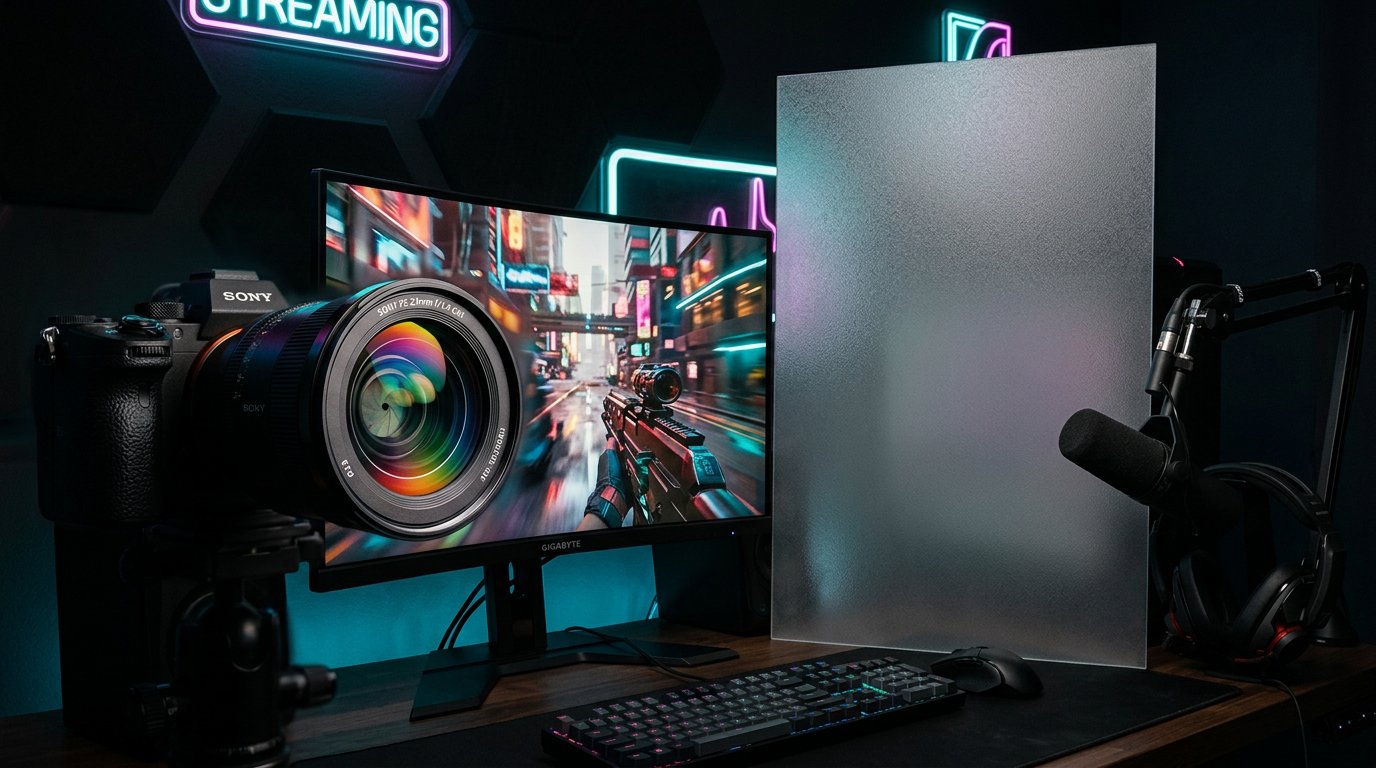
Why "Display Capture" is less suitable for an HDR game
"Display Capture" is useful for diagnostics: it helps verify what's happening on the entire screen. But as a permanent source, it depends on the desktop's HDR settings, window overlays, the second monitor, and how Windows hands the desktop to the application.
With this kind of capture, OBS may receive an already converted SDR frame instead of the game's source HDR signal. Then further tone mapping won't fix the image, because the source HDR data is already lost. The downside of this method is that the result may change after a driver update, a window switch, or connecting another display.
Where to look for tone mapping if HDR capture is enabled
If HDR capture is enabled but the OBS preview is still gray, first open the "Properties" of the "Game Capture" source specifically. Look for parameters related to color space, SDR White Level, HDR Nominal Peak Level, tone mapping, or HDR-to-SDR conversion.
The source shouldn't be forcibly interpreted as Rec.709 if the game outputs HDR. For SDR White Level, you can start with a reference of around 203 nits. This is the level of ordinary white in an HDR chain, not a universal setting to apply to every game.
For HDR Nominal Peak Level, specify the peak brightness the game is calibrated for. For example, if the in-game menu sets Peak Brightness to 1000 nits, start with 1000 in OBS as well. If the game is limited to a different value, specify the corresponding limit.
How to check a tone mapping error from a frame
If the specified peak is too low, OBS starts compressing bright areas too early. For example, the game is designed for a high peak but the source is set to a noticeably lower value: snow, clouds, and white walls become flat, and highlights look like a big bright blob.
If the peak is too high, the SDR image may become dull: ordinary light objects drift toward gray, and bright details take up too little of the SDR range. In a frame with a white interface, this is especially visible: the interface shouldn't look darker than an ordinary white web page on the same SDR monitor.
The downside of manual tuning is that settings that work well for a menu or a daytime location may look bad at night. Check at least three types of scenes: a dark room, a bright daytime frame, and a scene with fire, neon, or lamps.
Check the source filters in OBS
Select "Game Capture" in the sources list, right-click, and choose "Filters". In the effect filters block, check whether there's an HDR Tone Mapping Override or a similarly named filter. It's needed when the automatic HDR-to-SDR conversion gives an unsuitable result and the tone mapping method must be set explicitly.
Start with OBS's automatic values. If SDR White Level and peak level parameters are available, first transfer the values from the game's calibration into them. If a BT.2390 method is available, it can be used as a starting point for soft compression of bright highlights.
Reinhard and Hable can make the image visually more contrasty, but they may change the game's original look more. The downside of any manual method is that it doesn't fix an incorrect color range and doesn't replace correct capture settings.
Don't mask the problem with brightness and saturation
After tone mapping, don't add "Color Correction", a LUT, gamma, contrast, or saturation unless necessary. These filters may improve one frame but won't fix an incorrect Rec.2100 to Rec.709 conversion.
Raising saturation after poor tone mapping makes red and green elements look acid, but doesn't restore volume in bright areas. Raising contrast can hide gray black, but at the same time it removes detail in the shadows.
Change one parameter at a time and check the same frame each time. That way it will be clear whether tone mapping, the range, or something else fixed the setting, or whether it only temporarily masked the problem.
Encoder parameters for SDR and HDR
Open "Settings" → "Output" and check the active encoder. In advanced mode, make sure its profile, bit depth, and color format match the chosen chain. For an SDR broadcast with NV12, don't enable P010 and 10-bit HDR mode just for quality.
SDR needs Rec.709, NV12, and Limited. Native HDR usually needs a 10-bit chain with P010, Rec.2100 PQ, Limited, and an encoder that can pass HDR metadata. An unsuitable encoder may accept the OBS settings but send the stream without a correct HDR description.
The downside of HDR output is that even with a compatible graphics card, the platform may not accept a particular codec, profile, or HDR stream for a live broadcast. Before going live, it's worth running a short test and checking the technical data on the service side.
Compare the image at three points
Don't compare an HDR game on an HDR monitor and an SDR player literally: they don't have to be identical. Check the signal in three places — in the game, in the OBS preview, and in a test broadcast on an SDR device or a device with HDR turned off.
- The game looks right but the OBS preview is gray — the problem is in the capture, source properties, tone mapping, or color space.
- The OBS preview is fine but the broadcast is washed out — check Limited, the encoder parameters, and the platform's processing.
- The image is fine in the browser but not in the app on the phone — the cause may be the player or the service's SDR conversion.
- Only the recording after the broadcast looks washed out — look at which version of the video the platform delivers and how it transcoded the stream.
Pre-broadcast checklist: setup and three checks
- Enable HDR in Windows on the gaming monitor specifically, then enable HDR in the game itself and go through its calibration.
- Add "Game Capture", select the game process in the source properties, and enable HDR capture if OBS is to receive the HDR frame.
- For an SDR broadcast, open "Settings" → "Advanced" → "Video" and set NV12, Rec.709, Limited.
- If HDR capture is already enabled, open the source properties and check the HDR interpretation, SDR White Level, and HDR Nominal Peak Level.
- Open the source "Filters" and check HDR Tone Mapping Override if automatic tone mapping gives a gray or overexposed image.
- In the OBS preview, check a black background, a white interface, and a bright highlight: black shouldn't be gray, and white shouldn't be dim.
- Run a test broadcast and open it on an SDR device. If you're sending native HDR, separately make sure the platform marked the input as HDR and show the SDR version.
Last Articles
What has changed in design and functionality We have updated the website to make working with it faster and more convenient. The main changes affect ..
Good afternoon, I've collected all the news during this time.: 1. The main news is that prices for twitch viewers have been greatly reduced, while Tw..
1. Use promo code "December2025" for a 15% discount for all our viewers2. We have reduced the base prices for our configurator and the most affordable..
Twitch services are working stably, so we are ready to cooperate with squads, resellers, service owners, bot owners, and many others.Individual te..
We have completely updated our Twitch viewer services, and they are now working stably. We only use high-quality IP addresses for the viewers.The ..
Hello everyone! Today, we are announcing a new feature—"Twitch Viewer Configurator". Now, you can customize any plan for your Twitch channel. Choo..
Greetings, I have compiled a guide for streamers, which will be very relevant at the moment. Now YouTube and twitch have disabled monetization from vi..
We have finally developed the APINow it will be more convenient for our partner sites to work with us.To update the maximum tariffs for YouTube, an up..
Due to the huge popularity of the partnership services and referral program, we have made a cooperation table. The essence is very simple: more live a..
Our Services for Streamers






Our Services for Content Creators